Fast Fashion is now one of the biggest conveniences of today. It’s hard to pass up clothes that are sold for a cheaper rate, especially in today’s economy. Everything is so expensive, but at least we can get our drip for a couple bucks. And ya know, since you’re already buying something – might as well get a couple of other things while you’re at it. But this is where they get ya! Trick you into spending $100 on a bunch of pieces that you’ll probably wear a handful of times, instead of one or two things that you can pass down to your kids one day.
I’m not trying to harp on anyone. In reality, it’s hard to pass up on something that seems like such a good deal. This is what those companies are banking on. Especially with free returns and “buy now, pay later”. But in reality, there’s so much that comes with getting the cute shirt or skirt for super cheap. The workers and the environment are paying the price. And the consumer. If something feels too good to be true, it probably is. Spending $5 dollars for a cute skirt or top to be shipped to your door within a couple of days feels great. You don’t even have to go to the store anymore. We don’t see the first hand real price that comes with these “great deals” immediately, or sometimes ever.
Though, if you go looking for it – you will find it. So, let’s get into it and find out the illusions that make it less enticing.
First, what is fast fashion? The term was first coined in the 90s for clothing brands that push out trendy, inexpensive clothes at a crazy rate. Like stores and websites that release new styles weekly to keep up with the latest trends. Zara was the original fast fashion brand, now we have Shien, Forever 21, H&M, ect. These brands prioritize high quantity but low quality, producing everything at low cost without thinking of the high cost it does on the environment or the people that produce the clothing. The products are centralized on trends, so a lot of times people wear one piece – one time. The trends go by quickly, if it is no longer stylish, then why wear it? Or maybe not at all as the products are a bit of a catfish when purchasing online.
The Nitty Gritty : Fast Fashion is Made to Fall Apart With The Environment and Garment Workers Paying the Price
If something is only $5-$10, it usually isn’t going to last. The fabric is low quality, and the sewing is done at such a fast rate where the seams commonly rip. As fast fashion is a highly labor intensive industry – the workers are made to work as quickly as possible where each piece is not given the amount of attention needed to make a long lasting product. It truly is quantity over quality, and that reflects in our closets, as well.
If you have ever tried to pick up sewing; you know how truly difficult it is to make clothes. It is a lost talent that once many people, mostly women, knew how to do. When you think of how much work it takes to make a piece of clothing it doesn’t make sense why the prices would be so low. I’m beginning to sound like a broken record, but it’s because the clothing quality is so poor and the labor is so cheap. Employees, the environment, and us as the consumers are taken advantage of.
Most of the clothes we buy today are mostly made of polyester. Polyester is made from petroleum (oil) which is processed into synthetic plastic fibers that are then used to create the fabric (thesustainablefashionforum.com). It is inexpensive to produce which is why it is the highlight of the fash fashion industry. It is one of the reasons why these clothes are so cheap to mass produce. The environment takes the true cost of polyester with the amount of natural gasses, water, and dyes used in production. Cheap to buy, but costly to the planet. And of course as polyester is a plastic it does not break down naturally, even though it rips quite easily. There are some pieces that can last people years, and are worn over and over. Though, in the grand scheme of it all – most of the clothing bought from these cheaper brands are faulty of poor sewing, rushed production, or strictly following trends and eventually never worn again. Only to be either ripped, thrown out, or donated. Leaving us to feel like we wasted money just to add to the pile of clothes in the landfill. Don’t even get me started on the dang microplastics. But since I brought it up, research estimates that synthetic textiles are responsible for 35% of the microplastics in our oceans today (weforum.org). Isn’t that crazy?
It isn’t the sweet ladies’ fault who creates these clothes. And I say ladies because 80% of the garment factory workers are women between the ages of 18 and 35. Many of these women are single mothers that barely make a living wage, earthday.org reports that out of the 75 million factory workers worldwide, less than 2% earn a living wage. And the work seems to be endless with an average 10 hour work days, and sometimes 16-18 hours in the peak season (labourbehindthelabel.org). One woman reported how they cannot refuse overtime as their base wage is too low. And if they were to refuse, they are met with threats of dismissal and subject to penalties as well as verbal abuse (labourbehindthelabel.org). They are overworked in a stressful and toxic environment just trying to pay their bills and provide for their children. Not to mention that the garment factories are generally unsafe with spaces being over crowded, blocked exits, and poor ventilation. The owners do not care for the well being and safety of their workers. For instance, on April 24th, 2013, the Rana Plaza – an eight-story building – collapsed. This being the deadliest industrial incident in the history of the garment industry, with 1,134 fatalities and injuring thousands. As large structural cracks were found the day before – the garment factory owners ordered the workers to come in the next day (cleanclothes.org). The collapse of the Raza Plaza was not just an accident, but a result of a system that exploits and endangers its workers.
With This Being Said . . .
As the clothing produced by fast fashion companies has a limited lifespan – it inevitably ends up in the landfill, with 85% of textiles going to the landfill each year (unric.org). Even if you don’t throw away your clothes, and you always try to donate – the donation centers have such an influx of products where if the clothes are not bought between a certain amount of time – they will be thrown away eventually. Don’t get me wrong, though, keep donating! It is just something to keep in mind. Same thing with return policies. Ideally when returning clothes, they would end up back on the shelf or to be sold through the site. Companies have such a large amount of returns where they are usually sold to liquidators or sent to the landfill. Likewise with the clothes that are never sold through the site, they are sold in bulk to liquidators. If they are not bought in liquidation sale stores – then they are put back on a truck to be driven to a landfill. 10% of the world’s emissions in the fashion industry alone (in production and shipping either to a store or to someone’s home) usually for clothing that was never worn (unric.org). Of course, a lot of these concerns are thrown back at the consumer, but in reality these large companies are at fault for bringing us into their trap of over consumption.
The environmental concern for this system is valid and even if the deal feels too good to pass up, maybe think to yourself, “is this something I can wear more than a handful of times” or “is this something I could give to another person in good conscious if I don’t like or fit it anymore?”.
What You Can Do Instead
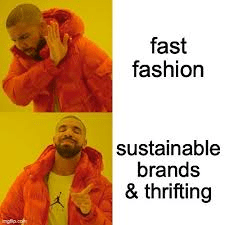
When shopping for clothes – I try to think of timeless or staple pieces. Is this something I would love for years, no matter how much my style has changed? Of course, styles change as people change. Clothes reflect personality and it’s important to wear something that makes you feel comfortable and confident. Though, there are ways to buy clothes without going through brands that don’t prioritize the environment, their staff, and their customers. Many brands today are starting to go green with focusing on long lasting clothes as well as fair labor. These brands are a bit pricey. Like I mentioned earlier, if it’s too good to be true, then it probably is. It is ideal to spend a bit more money on clothes you know you can wear 100+ times for years, instead of spending the same money on 7 different shirts that you would only wear a couple of times. Avoid impulse buying, and buy less for better quality.
Even if you’re not someone who’s into green living, avoiding fast fashion can still save you money, closet space, and guilt over waste.
Citations :
https://cleanclothes.org/campaigns/past/rana-plaza
https://unric.org/en/from-petroleum-to-pollution-the-cost-of-polyester/
https://www.weforum.org/stories/2019/12/microplastics-ocean-plastic-pollution-research-salps/
 Go Green Girl
Leave a comment